
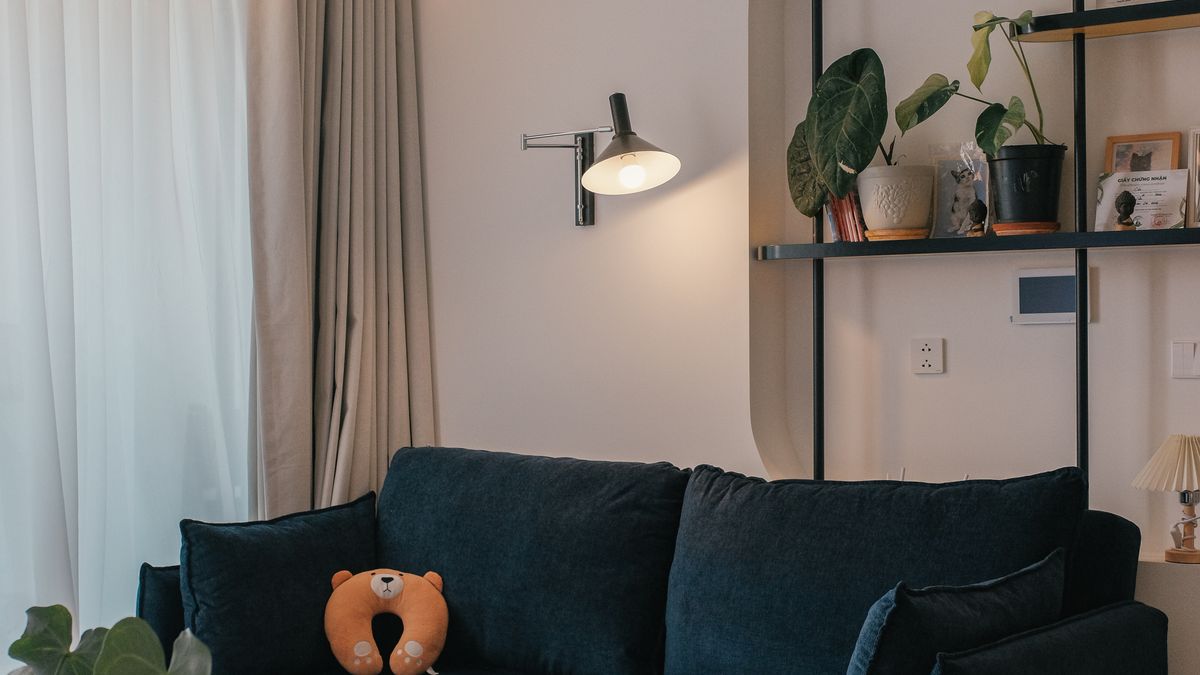
A single pendant blazing away in the middle of the ceiling is the quickest way to make a sitting room feel flat. It lights the carpet brightly, throws your face into shadow and leaves the corners gloomy. Warmth in a living room is rarely about brightness — it is about layers. Several softer sources at different heights give the eye somewhere to rest and make a room feel occupied, even when you are the only one in it.
A useful rule of thumb for a typical 4m x 4m sitting room is three to five light sources, each doing a slightly different job. Think of it as a cake: a ceiling layer on top, lamps in the middle, and small pools of light at the bottom. Get those three tiers working together and you can move from bright daylight tasks to a low, golden evening without ever touching a main switch in a hurry.
You do not need to remove the pendant or the downlights, but you do need to tame them. If the fitting will take one, a dimmer switch is the single best upgrade in the room. Run the ceiling light at 30–40 per cent after dark and it stops being the star of the show and becomes a gentle wash across the ceiling and walls.
If you have a multi-bulb fitting, consider swapping one or two bulbs for lower-output ones so the light is less uniform. With recessed downlights, ask an electrician about dimmable versions and put them on a separate circuit from the lamps if you can — it means you can kill the overhead light entirely in the evening while keeping everything else on. A wall-washing uplighter in a corner does a similar job and makes a small room feel taller.
Table lamps are where most of the warmth actually comes from. Place them so the shade sits at roughly eye level when you are seated — somewhere between 45cm and 60cm above the floor for a lamp on a side table. Too low and you get glare across the sofa; too high and it lights the top of your head.
A slim lamp on a console table behind the sofa works well in open-plan rooms, throwing light onto the back wall and separating the seating area from the kitchen without a physical divide.
Dark corners make a room feel smaller than it is. A floor lamp in the corner behind an armchair does two jobs at once: it fills that dead space with light and gives whoever sits there a comfortable reading source over their shoulder. Look for one with a weighted base and a shade you can tilt, so you can aim it at a book rather than at the telly.
An arc floor lamp over the sofa is a good option if you are short on table space, and an uplighter with a small side arm gives you both a ceiling wash and a downward pool of light. Where floor space is tight, a plug-in wall light at the same height as a floor lamp achieves the same effect with nothing to trip over. Add a trailing lead in a fabric braid and run it along the skirting to keep it tidy.
The final tier is the one people skip, and it is often the one that makes guests say a room feels cosy. Small, low-output sources add depth because they create pools of light instead of general brightness.
The trick is restraint. Two or three accent points in a room is plenty; any more and it starts to look like a shop window.
None of the above works if the bulbs fight you. For a living room, look for warm white LEDs in the 2700K range, or 2200K if you want a distinctly golden, candle-like feel. Anything at 4000K or above will read as cold and clinical, no matter how lovely the lampshade is.
Check the lumens rather than the wattage. A 5–8W LED giving around 470–800 lumens is roughly equivalent to an old 40–60W bulb, which is plenty for a table lamp. Look for bulbs marked as dimmable if you plan to use a dimmer, and choose ones with a high colour rendering index (90+) so wood, fabric and skin tones look natural rather than grey.
Finally, think about control. Putting the two lamps, the floor lamp and the ceiling light on one smart plug or a simple remote means you can shift the room from bright to intimate in a single press. Set the ceiling light to come on with the lamps in the morning, then switch it off and leave the lamps running as the evening draws in. That slow shift from daylight to lamplight is what makes a sitting room feel genuinely warm — and it costs very little to set up.

Hi, my name is Anthony kuber. I am artist and fashion designer.
I love to travel and writing blogging.
Your email address will not be published. Required fields are marked *
Software Developer & Writer
Hey, I'm Diva, a developer and writer blending code and creativity. I'm driven by a deep curiosity and a relentless pursuit of excellence. Join me as I craft digital solutions and captivating stories.


